all-that-is-golden

  • Subscribe to our RSS feed.
  • Twitter
  • StumbleUpon
  • Reddit
  • Facebook
  • Digg
Showing posts with label jules verne. Show all posts

Monday, 27 August 2012

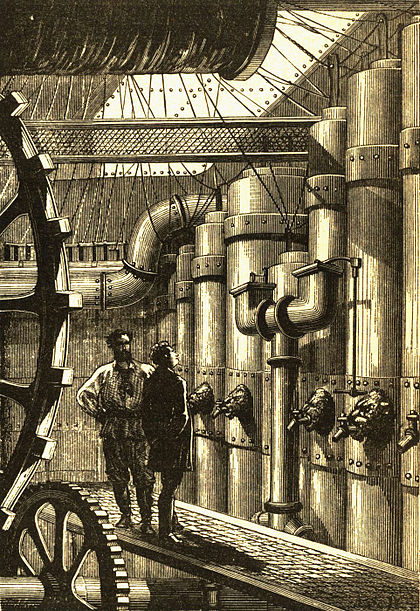
20,000 Leagues: Calm Before the Storm

Posted on 06:00 by simmo
Vingtmillelieue00vern orig 0146 1
In my last post, I mentioned briefly the scene in which--following Nemo's suspicious behavior--Aronnax, Conseil, and Ned Land are drugged, only to wake up with no memory of what happened in the interval.  A little later, Aronnax (apparently also a doctor) is taken to see one of the crew.  This man has a serious injury, from which he eventually dies.  He is then buried under the floor of the sea, and this ends Part I of the book.

Up until now, Aronnax and his friends have led a relatively quiet life on the Nautilus, deeply engrossed in scientific studies and the wonders of the underwater world.  This incident comes as a bit of a shock, a reality check nobody wanted.  Had the previous chapters been nothing but a "rip-roaring adventure", maybe this wouldn't have been such a big deal; however, as it is, the contrast makes it horrifying.

The key to a good sea-story epic is, pardon the pun, the "calm before the storm".  The Old Man and the Sea (Hemingway) and Moby-Dick (Melville) display the same brooding calm, before anything exciting happens.  What makes this technique (if it even be intentional) so appealing is its reality.  Most of us could liken our lives to a sea voyage, a daily routine that hardly ever changes, yet when something happens, the effect it creates is almost surreal.

One more "storm": I'm three chapters into Part II, and Ned Land has just saved Nemo's life while Nemo was trying to protect a pearl fisher from a shark attack (the plot is really picking up).  The stakes are higher in the Disney movie, and I find it interesting that movie!Ned's reaction is "Why did I do that?!", as opposed to book!Ned's "I owed it to you".  Though I believe in his benevolence/heroism in both versions, it's hard to believe he would say what book!Ned said. 

I should add that I'm really enjoying this translation. There are a number of anachronistic word choices (some of which are rather funny), but somehow it works well in this particular book...I'm not sure I'd want to read it any other way! 

I'm also starting to remember a lot of scenes from when I read it before.  Like the part where Aronnax freaks out at the idea of hunting sharks, and Ned and Conseil disappoint him by being ok with it.  XD  The hunting trip on the island was also pretty hilarious.  This also led me to look up "coconut crab" on Wikipedia, which I do NOT recommend for the faint of courage. 
Read More
Posted in 20000 Leagues, book commentary, book review, jules verne | No comments

Thursday, 23 August 2012

20,000 Leagues: Even Studious Types Get in Trouble

Posted on 08:52 by simmo
While truly intrigued by this book, less than halfway through I finally asked myself, "Why are these guys STILL on the Nautilus?  Why hasn't Ned gone through the roof yet?  Isn't that one thing Disney got right?!"

But I forgot.  We're dealing with very bookish characters here.  Professor Aronnax, a marine biology expert who jumped at the chance of hunting for a legendary, gigantic narwhal.  Conseil, a self-motivated student whose favorite habit is to classify things constantly.  The Nautilus provides the highlight of their studies--which is practically everything they live for.

Captain Nemo knew he didn't need to lock them up in a cell.  Their lust for knowledge would be their own prison, and the harpooner Ned Land, who still retained a natural thirst for liberty, was outnumbered by two men with the gift of persuasion, rather than force.  Conseil put it in plain words: he had no desire to go back to civilization. Professor Aronnax, faced with the first opportunity of escape (to the Indian subcontinent), declares evasively:
   "No, no, Ned. . .Let's ride it out, as you seafaring fellows say. The Nautilus is approaching populated areas. It's going back toward Europe, let it take us there. After we arrive in home waters, we can do as we see fit. Besides, I don't imagine Captain Nemo will let us go hunting on the coasts of Malabar or Coromandel as he did in the forests of New Guinea."
   "Well, sir, can't we manage without his permission?"
   I didn't answer the Canadian. I wanted no arguments. Deep down, I was determined to fully exploit the good fortune that had put me on board the Nautilus.
And this, after the drugging incident, which caused Aronnax to suspect Nemo of sinking a ship during their unconsciousness!

The question remains: ultimately, did Ned save their lives, or did Conseil and the professor save his?  It is true that, had it not been for Aronnax and Conseil's presence, Nemo would probably have left Ned to die.  On the other hand, had Ned given up on escape, the three (or two) of them would have spent the rest of their lives on the Nautilus and not in "the real world", where they belonged.

Movie!Ned puts it aptly: "I feel like a knife that's just stabbed a friend in the back."  However great its scientific treasures, the Nautilus is just that: a prototype for submarine warfare (scarcely preceded by that used in the U.S. Civil War). Aronnax may genuinely believe what he learns on the Nautilus could be used for the greater good--Conseil and he might be willing to give their lives for it--but does it justify his ignoring Nemo's crimes?

Ned may not be a brilliant scholar, but what he lacks in academics he makes up for in common sense.  Everyone needs a friend like him, especially those of us whose heads might easily get turned by our individual interests.  *raises hand*


Read More
Posted in 20000 Leagues, book commentary, book review, jules verne | No comments

Tuesday, 21 August 2012

20,000 Leagues: How to Write a Good Introduction

Posted on 17:53 by simmo
Vingtmillelieue00vern orig 0131 1 detail
For me, 20,000 Leagues Under the Sea is a deliciously vague childhood memory, much like Cinderella or The Children's Book of Virtues.  It was always there, without a memorable first time.  I remember Mom reading the book to me, and I remember reading parts of it myself, but just vaguely.

I'm now reading/re-reading the whole thing.  I found a splendid Gutenberg translation by F. P. Walters, complete with a Units of Measure table and a first-rate introduction.  If you know my reading habits, you know I am highly particular about translations and infamously distrustful of introductions.  I can't tell you how many I have seen that are laden with spoilers and/or (worse yet) ideological agenda.

Here is a rare gem, an example of a Good Introduction, and why it is so (my words in bold):

"The deepest parts of the ocean are totally unknown to us," admits Professor Aronnax early in this novel. "What goes on in those distant depths? What creatures inhabit, or could inhabit, those regions twelve or fifteen miles beneath the surface of the water? It's almost beyond conjecture."

Opens with a quote: straightforward, down-to-earth, and catchy. 

Jules Verne (1828–1905) published the French equivalents of these words in 1869, and little has changed since. 126 years later, a Time cover story on deep–sea exploration made much the same admission: "We know more about Mars than we know about the oceans." This reality begins to explain the dark power and otherworldly fascination of Twenty Thousand Leagues Under the Seas.

Author's life span, original language, date of original publication, date of this translation's publication, connection to the present.  Perfection.

Born in the French river town of Nantes, Verne had a lifelong passion for the sea. First as a Paris stockbroker, later as a celebrated author and yachtsman, he went on frequent voyages—to Britain, America, the Mediterranean. But the specific stimulus for this novel was an 1865 fan letter from a fellow writer, Madame George Sand. She praised Verne's two early novels Five Weeks in a Balloon (1863) and Journey to the Center of the Earth (1864), then added: "Soon I hope you'll take us into the ocean depths, your characters traveling in diving equipment perfected by your science and your imagination." Thus inspired, Verne created one of literature's great rebels, a freedom fighter who plunged beneath the waves to wage a unique form of guerilla warfare.

Succinct author biog, inspiration for novel (plus name-dropping for classic lit geeks), reference to other Verne novels, indirect introduction to Nemo.

Initially, Verne's narrative was influenced by the 1863 uprising of Poland against Tsarist Russia. The Poles were quashed with a violence that appalled not only Verne but all Europe. As originally conceived, Verne's Captain Nemo was a Polish nobleman whose entire family had been slaughtered by Russian troops. Nemo builds a fabulous futuristic submarine, the Nautilus, then conducts an underwater campaign of vengeance against his imperialist oppressor.

Version 1 of Nemo, with a hint as to v2's motives.

But in the 1860s France had to treat the Tsar as an ally, and Verne's publisher, Pierre Hetzel, pronounced the book unprintable. Verne reworked its political content, devising new nationalities for Nemo and his great enemy—information revealed only in a later novel, The Mysterious Island (1875); in the present work Nemo's background remains a dark secret. In all, the novel had a difficult gestation. Verne and Hetzel were in constant conflict and the book went through multiple drafts, struggles reflected in its several working titles over the period 1865–69: early on, it was variously called Voyage Under the Waters, Twenty–five Thousand Leagues Under the Waters, Twenty Thousand Leagues Under the Waters, and A Thousand Leagues Under the Oceans.

Mention of a sequel (always good to know), working titles, plus the agonies of working with a publisher.  ;)

Verne is often dubbed, in Isaac Asimov's phrase, "the world's first science–fiction writer." And it's true, many of his sixty–odd books do anticipate future events and technologies: From the Earth to the Moon (1865) and Hector Servadac (1877) deal in space travel, while Journey to the Center of the Earth features travel to the earth's core. But with Verne the operative word is "travel," and some of his best–known titles don't really qualify as sci–fi: Around the World in Eighty Days (1872) and Michael Strogoff (1876) are closer to "travelogs"—adventure yarns in far–away places.

Reaffirms Verne's reputation and hints his books are best read for the adventure, not the science, necessarily.

These observations partly apply here. The subtitle of the present book is An Underwater Tour of the World, so in good travelog style, the Nautilus's exploits supply an episodic story line. Shark attacks, giant squid, cannibals, hurricanes, whale hunts, and other rip–roaring adventures erupt almost at random. Yet this loose structure gives the novel an air of documentary realism. What's more, Verne adds backbone to the action by developing three recurring motifs: the deepening mystery of Nemo's past life and future intentions, the mounting tension between Nemo and hot–tempered harpooner Ned Land, and Ned's ongoing schemes to escape from the Nautilus. These unifying threads tighten the narrative and accelerate its momentum.

Reasons (excellent ones) to read the book.

Other subtleties occur inside each episode, the textures sparkling with wit, information, and insight. Verne regards the sea from many angles: in the domain of marine biology, he gives us thumbnail sketches of fish, seashells, coral, sometimes in great catalogs that swirl past like musical cascades; in the realm of geology, he studies volcanoes literally inside and out; in the world of commerce, he celebrates the high–energy entrepreneurs who lay the Atlantic Cable or dig the Suez Canal. And Verne's marine engineering proves especially authoritative. His specifications for an open–sea submarine and a self–contained diving suit were decades before their time, yet modern technology bears them out triumphantly.

Historic, scientific, and prophetic importance of the book.

True, today's scientists know a few things he didn't: the South Pole isn't at the water's edge but far inland; sharks don't flip over before attacking; giant squid sport ten tentacles not eight; sperm whales don't prey on their whalebone cousins. This notwithstanding, Verne furnishes the most evocative portrayal of the ocean depths before the arrival of Jacques Cousteau and technicolor film.

Lastly the book has stature as a novel of character. Even the supporting cast is shrewdly drawn: Professor Aronnax, the career scientist caught in an ethical conflict; Conseil, the compulsive classifier who supplies humorous tag lines for Verne's fast facts; the harpooner Ned Land, a creature of constant appetites, man as heroic animal.

Atmosphere, interesting characters, and name-dropping most people will appreciate.

SEMI-SPOILERS ahead:

But much of the novel's brooding power comes from Captain Nemo. Inventor, musician, Renaissance genius, he's a trail–blazing creation, the prototype not only for countless renegade scientists in popular fiction, but even for such varied figures as Sherlock Holmes or Wolf Larsen. However, Verne gives his hero's brilliance and benevolence a dark underside—the man's obsessive hate for his old enemy. This compulsion leads Nemo into ugly contradictions: he's a fighter for freedom, yet all who board his ship are imprisoned there for good; he works to save lives, both human and animal, yet he himself creates a holocaust; he detests imperialism, yet he lays personal claim to the South Pole. And in this last action he falls into the classic sin of Pride. He's swiftly punished. The Nautilus nearly perishes in the Antarctic and Nemo sinks into a growing depression.

Like Shakespeare's King Lear he courts death and madness in a great storm, then commits mass murder, collapses in catatonic paralysis, and suicidally runs his ship into the ocean's most dangerous whirlpool. Hate swallows him whole.

I've never in my life compared Holmes to Nemo; these two paragraphs are rather fascinating. 

For many, then, this book has been a source of fascination, surely one of the most influential novels ever written, an inspiration for such scientists and discoverers as engineer Simon Lake, oceanographer William Beebe, polar traveler Sir Ernest Shackleton. Likewise Dr. Robert D. Ballard, finder of the sunken Titanic, confesses that this was his favorite book as a teenager, and Cousteau himself, most renowned of marine explorers, called it his shipboard bible.

Connection to real-life heroes in the same genre.

The present translation is a faithful yet communicative rendering of the original French texts published in Paris by J. Hetzel et Cie.—the hardcover first edition issued in the autumn of 1871, collated with the softcover editions of the First and Second Parts issued separately in the autumn of 1869 and the summer of 1870. Although prior English versions have often been heavily abridged, this new translation is complete to the smallest substantive detail.

Good to know.

Because, as that Time cover story suggests, we still haven't caught up with Verne. Even in our era of satellite dishes and video games, the seas keep their secrets. We've seen progress in sonar, torpedoes, and other belligerent machinery, but sailors and scientists—to say nothing of tourists—have yet to voyage in a submarine with the luxury and efficiency of the Nautilus.

Call to action/challenge to read the book, and why it is still worth reading.

F. P. WALTER
University of Houston
Read More
Posted in 20000 Leagues, book commentary, book review, jules verne | No comments

Monday, 7 February 2011

Jules Verne

Posted on 22:30 by simmo
Jules Verne was a science fiction author born on February 8, 1828.  Check out Google's interactive logo tribute!

Jules Verne is of the most amazing authors I've read.  Though famous for being "the father of science fiction" he is, relatively speaking, not very popular these days; and his real genius is often underrated, either by inaccurate movie adaptations or the simple fact that most of his books are ignored.  His most famous novels are 20,000 Leagues Under the Sea, Around the World in Eighty Days, and Journey to the Center of the Earth--but these three titles are only a fraction of his "Extraordinary Voyages" collection, which is comprised of at least 50 other sci-fi/adventure novels.  A mind-boggling number, considering all the research he would have had to do! :)

Sadly to say, these other works are often hard to come by--even from libraries--and often times the accuracy of the translations are dubious.  Even if there are English translations they usually aren't budget-friendly (unlike e-book reader versions, and for that reason I might just have to get an e-book reader).  Anyhow, years ago I was really into reading Verne, and I was happily able to find and read some of these more obscure books, namely:
  • The Mysterious Island (sequel to 20,000 Leagues)
  • Five Weeks in a Balloon
  • Two Years’ Holiday
  • The Green Ray
  • The Mighty Orinoco
  • The Lighthouse At the End of the World
  • The Clipper of the Clouds  
  • Paris in the Twentieth Century
    Half of these nobody's ever heard of, which is too bad, since all of them (except Mighty Orinoco) were worthwhile reads.  And there's still tons more, like The Golden Volcano and Facing the Flag, which I've only just recently heard of, but they sound excellent.

    Anyhow, I highly recommend his books.  :)  And though I've yet to see any accurate movies, the old classics such as Disney's 20,000 Leagues Under the Sea, and the new Journey to the Center of the Earth (2008), are great movies that stay true to the spirit of his stories.

    post signature
    Read More
    Posted in books, jules verne | No comments

    Thursday, 8 April 2010

    Movie Review: Journey to the Center of the Earth

    Posted on 17:50 by simmo
    This is a short movie review I wrote a couple years ago.  I saw this film in 2D and later in 3D (which was amazing), but I think it's just as good in 2D.  :)


    Journey to the Center of the Earth (2008)

    Director: Eric Brevig
    Starring: Brendan Fraser, Josh Hutcherson, Anita Briem, etc.
    Rated: PG.  Apparently there's also a PG-13 special edition, but I've never seen it.
    My overall rating:  5 out of 5 stars.  Highly recommended!

       Moviegoers of all ages were given a rare treat this summer with the July release of Journey to the Center of the Earth, a film anticipated mainly because of its 3D effects. The adventure starts out in 2007 with an American scientist, Trevor Anderson, whose humdrum life suddenly changes when his computer reports new seismic activity—facts that might tell him how his brother disappeared ten years ago. Together with his electronics-savvy nephew and a shrewd blonde mountain guide, he heads up the Icelandic Mt. Sneffels to collect the data, only to fall, literally, into the center of the earth. There, surrounded by prehistoric creatures and natural wonders, they race against time and temperatures to find their way back out.
       This film, both visually and aurally, exceeded my expectations: from bird's eye views of Iceland to majestic underground caverns, the colorful landscapes portray the realism, beauty, and grandeur of both worlds, and are pieces of art in themselves. It's all the more impressive considering that most of the sets and all of the creatures are CGI; probably the best prehistoric creatures were the sea-monsters, swinging their long necks around and splashing through the underground ocean in alarming numbers. And as for 3-D effects, they're cool if you can find a theater that shows them, but they're not really necessary to help you enjoy the film. Rain, glowing atmospheres, and exciting first-person shots help keep you entranced, as does the musical score which swells, scintillates and serves as an enhancement, not a distraction. Everything works together, balancing beautifully to create a fantasy land that you can take relatively seriously.
       Perhaps a bigger surprise was the film's script. In the spirit of most Jules Verne movies, I expected a good dose of corniness, but happily I was proven wrong; the dialogue was clever, and there was little or no corn. The characters are pretty realistic, and I actually ended up liking the mountain guide—for once, a Verne heroine that's not annoying! The romance isn't overblown, the action is everywhere, and there is no bad language, to top it off. Also, as fan of the original book and Jules Verne's works in general, I found this movie's 21st century setting an excellent tribute to the novel; the protagonists read the book as kind of guide or source of hints, and scenes such as the mushroom forest and the raft ride are recreated in a way quite loyal to the book.
       If you enjoy a good story, suspenseful action, and stunning effects, give this one a try: it'll take you on a thrilling, engaging journey in just 90 minutes.


    post signature
    Read More
    Posted in jules verne, movie review | No comments
    Older Posts Home
    Subscribe to: Posts (Atom)

    Popular Posts

    • Opinions wanted: happy endings vs. sad endings
      Pretty much what the title says...I'd like to hear what everyone thinks about this:  when you get close to the end of a really, really g...
    • Tagged by Gwyn
      The Writer's Tag Rules:  Fill out the tag, and then add two of your own questions! What do you write your stories on? These days, I grab...
    • Celtic Thunder Christmas!
      Can't wait...  :)
    • Book Review: "...you are a clever lad, and you ask advice--mind you follow it, or it's little use asking it."
      <a href="http://...
    • Opinions wanted: Short chapters vs. long chapters
      [By the way, please vote on the poll on the sidebar if you haven't done so already!  =) ] When I outline a story, I almost always decide...
    • Costume Series: Heroines
      Updated:   July 2011 My #1 sewing obsession is replicating or designing 11 1/2 inch doll-sized costumes of characters (usually from literatu...
    • What I've been reading and sewing
      I've been working on various different sewing projects.  I meant to post this sooner, but here are pictures of a doll dress I finished t...
    • Name for a character?
      As I mentioned before, I'm writing a historically-inspired, 18th-century story, sort of like Sleeping Beauty but not exactly; and I need...
    • The Cheshire Cat
      Almost Alice:  August 1-7 www.shieldmaidenthoughts.wordpress.com  I love the Cheshire Cat!  He's such a funny, eerie, and original chara...
    • BBC Sherlock...new trailer!
      Click here Holmes is very cold and arrogant in this version, isn't he?  Even though he's supposed to be cold and arrogant (at the be...

    Categories

    • 'space--the final frontier'
    • #can't even
    • ♬ classical music Monday
    • 20000 Leagues
    • 30 day challenge
    • about me
    • Adam Young
    • alice in wonderland
    • announcement
    • april fools day
    • art
    • austen
    • bach
    • birthday
    • book commentary
    • book review
    • books
    • books on the brain
    • bronte
    • Canadian Rockies 2011
    • Caspar David Friedrich
    • Celtic Thunder
    • character analysis
    • Character Letters
    • chesterton
    • chopin
    • Christmas 2009
    • Christmas 2010
    • Christmas 2011
    • Christmas 2012
    • Christmas 2013
    • coffee
    • computer science
    • conrad
    • cooking
    • costume drama
    • costumes
    • Createspace
    • cryptozoology
    • debussy
    • dickens
    • domingo
    • e-readers
    • Easter 2012
    • Easter 2013
    • excerpts from books
    • facts I will know forever
    • Faulkner
    • FicSwap 2010
    • geekery
    • gimp tutorial
    • Glimpses of Goodness
    • green tea
    • guest post
    • health
    • hello
    • heroes
    • Heroines Costume Series
    • Historical Costume Inspiration Festival
    • homeschool
    • Hornblower
    • humor
    • hvorostovsky
    • I ♥ Thursday
    • Jane Eyre event
    • journal 1
    • jules verne
    • July 4 1776
    • Kindle Direct Publishing
    • Lent
    • life advice
    • life and times
    • life is sweet
    • link recs
    • Literary Heroine Blog Party
    • lord of the rings
    • LPW
    • math
    • mendelssohn
    • moby-dick quotes
    • movie review
    • mozart
    • music
    • music video
    • my writing
    • mystery solved
    • nail polish review
    • nanowrimo 2013
    • narnia
    • National Poetry Day
    • new year 2012
    • New Year 2013
    • New Year 2014
    • news article
    • nonsense words
    • on my mind
    • on writing
    • open letters
    • opera
    • opera review
    • opinions wanted
    • pacific northwest
    • paper dolls
    • patriotic
    • people
    • personal
    • photo challenge
    • photos
    • pi day
    • piano
    • picspam
    • poetry
    • politics matter
    • quotes
    • random
    • randomosities
    • reichenbach fall
    • Rhett and Link
    • Robinson Crusoe Read-Along
    • school
    • schumann
    • sewing
    • shaham
    • sherlock holmes
    • ships
    • short story
    • snippets of story
    • somewhat random
    • St Valentine's Day
    • steampunk
    • summer
    • summer 2013
    • summertime ramblings
    • Summertime's End
    • tagged
    • tchaikovsky
    • thanksgiving
    • the hobbit
    • the mind of an author
    • the sea
    • the virginian
    • tutorial
    • tv review
    • very random
    • video
    • violin
    • vita reale
    • Weekend Quote
    • writing

    Blog Archive

    • ▼  2013 (57)
      • ▼  December (7)
        • 2013 Recap + Big Announcement
        • Merry Christmas Eve!
        • The Orange Orchard
        • The Hobbit: The Desolation of Smaug (reactions par...
        • The Hobbit: The Desolation of Smaug (reactions par...
        • Beware the Frozen Heart
        • Lights
      • ►  November (7)
      • ►  October (4)
      • ►  September (2)
      • ►  August (15)
      • ►  July (6)
      • ►  May (2)
      • ►  April (2)
      • ►  March (2)
      • ►  February (4)
      • ►  January (6)
    • ►  2012 (170)
      • ►  December (10)
      • ►  November (8)
      • ►  October (10)
      • ►  September (13)
      • ►  August (19)
      • ►  July (24)
      • ►  June (9)
      • ►  May (15)
      • ►  April (6)
      • ►  March (17)
      • ►  February (17)
      • ►  January (22)
    • ►  2011 (140)
      • ►  December (15)
      • ►  November (7)
      • ►  October (14)
      • ►  September (13)
      • ►  August (6)
      • ►  July (10)
      • ►  June (20)
      • ►  May (14)
      • ►  April (11)
      • ►  March (13)
      • ►  February (9)
      • ►  January (8)
    • ►  2010 (125)
      • ►  December (6)
      • ►  November (9)
      • ►  October (12)
      • ►  September (15)
      • ►  August (12)
      • ►  July (10)
      • ►  June (12)
      • ►  May (9)
      • ►  April (8)
      • ►  March (12)
      • ►  February (10)
      • ►  January (10)
    • ►  2009 (8)
      • ►  December (8)
    Powered by Blogger.

    About Me

    simmo
    View my complete profile