all-that-is-golden

  • Subscribe to our RSS feed.
  • Twitter
  • StumbleUpon
  • Reddit
  • Facebook
  • Digg
Showing posts with label book review. Show all posts

Monday, 27 August 2012

20,000 Leagues: Calm Before the Storm

Posted on 06:00 by simmo
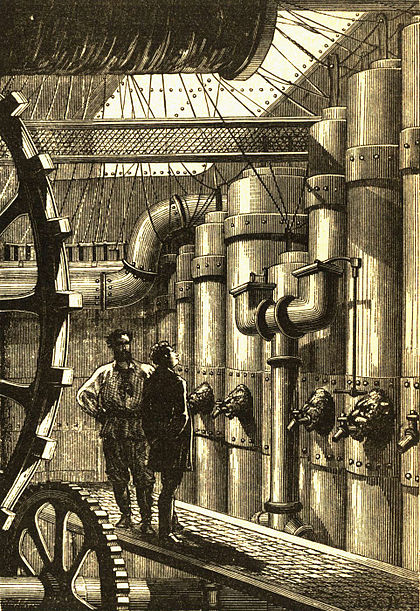
Vingtmillelieue00vern orig 0146 1
In my last post, I mentioned briefly the scene in which--following Nemo's suspicious behavior--Aronnax, Conseil, and Ned Land are drugged, only to wake up with no memory of what happened in the interval.  A little later, Aronnax (apparently also a doctor) is taken to see one of the crew.  This man has a serious injury, from which he eventually dies.  He is then buried under the floor of the sea, and this ends Part I of the book.

Up until now, Aronnax and his friends have led a relatively quiet life on the Nautilus, deeply engrossed in scientific studies and the wonders of the underwater world.  This incident comes as a bit of a shock, a reality check nobody wanted.  Had the previous chapters been nothing but a "rip-roaring adventure", maybe this wouldn't have been such a big deal; however, as it is, the contrast makes it horrifying.

The key to a good sea-story epic is, pardon the pun, the "calm before the storm".  The Old Man and the Sea (Hemingway) and Moby-Dick (Melville) display the same brooding calm, before anything exciting happens.  What makes this technique (if it even be intentional) so appealing is its reality.  Most of us could liken our lives to a sea voyage, a daily routine that hardly ever changes, yet when something happens, the effect it creates is almost surreal.

One more "storm": I'm three chapters into Part II, and Ned Land has just saved Nemo's life while Nemo was trying to protect a pearl fisher from a shark attack (the plot is really picking up).  The stakes are higher in the Disney movie, and I find it interesting that movie!Ned's reaction is "Why did I do that?!", as opposed to book!Ned's "I owed it to you".  Though I believe in his benevolence/heroism in both versions, it's hard to believe he would say what book!Ned said. 

I should add that I'm really enjoying this translation. There are a number of anachronistic word choices (some of which are rather funny), but somehow it works well in this particular book...I'm not sure I'd want to read it any other way! 

I'm also starting to remember a lot of scenes from when I read it before.  Like the part where Aronnax freaks out at the idea of hunting sharks, and Ned and Conseil disappoint him by being ok with it.  XD  The hunting trip on the island was also pretty hilarious.  This also led me to look up "coconut crab" on Wikipedia, which I do NOT recommend for the faint of courage. 
Read More
Posted in 20000 Leagues, book commentary, book review, jules verne | No comments

Thursday, 23 August 2012

20,000 Leagues: Even Studious Types Get in Trouble

Posted on 08:52 by simmo
While truly intrigued by this book, less than halfway through I finally asked myself, "Why are these guys STILL on the Nautilus?  Why hasn't Ned gone through the roof yet?  Isn't that one thing Disney got right?!"

But I forgot.  We're dealing with very bookish characters here.  Professor Aronnax, a marine biology expert who jumped at the chance of hunting for a legendary, gigantic narwhal.  Conseil, a self-motivated student whose favorite habit is to classify things constantly.  The Nautilus provides the highlight of their studies--which is practically everything they live for.

Captain Nemo knew he didn't need to lock them up in a cell.  Their lust for knowledge would be their own prison, and the harpooner Ned Land, who still retained a natural thirst for liberty, was outnumbered by two men with the gift of persuasion, rather than force.  Conseil put it in plain words: he had no desire to go back to civilization. Professor Aronnax, faced with the first opportunity of escape (to the Indian subcontinent), declares evasively:
   "No, no, Ned. . .Let's ride it out, as you seafaring fellows say. The Nautilus is approaching populated areas. It's going back toward Europe, let it take us there. After we arrive in home waters, we can do as we see fit. Besides, I don't imagine Captain Nemo will let us go hunting on the coasts of Malabar or Coromandel as he did in the forests of New Guinea."
   "Well, sir, can't we manage without his permission?"
   I didn't answer the Canadian. I wanted no arguments. Deep down, I was determined to fully exploit the good fortune that had put me on board the Nautilus.
And this, after the drugging incident, which caused Aronnax to suspect Nemo of sinking a ship during their unconsciousness!

The question remains: ultimately, did Ned save their lives, or did Conseil and the professor save his?  It is true that, had it not been for Aronnax and Conseil's presence, Nemo would probably have left Ned to die.  On the other hand, had Ned given up on escape, the three (or two) of them would have spent the rest of their lives on the Nautilus and not in "the real world", where they belonged.

Movie!Ned puts it aptly: "I feel like a knife that's just stabbed a friend in the back."  However great its scientific treasures, the Nautilus is just that: a prototype for submarine warfare (scarcely preceded by that used in the U.S. Civil War). Aronnax may genuinely believe what he learns on the Nautilus could be used for the greater good--Conseil and he might be willing to give their lives for it--but does it justify his ignoring Nemo's crimes?

Ned may not be a brilliant scholar, but what he lacks in academics he makes up for in common sense.  Everyone needs a friend like him, especially those of us whose heads might easily get turned by our individual interests.  *raises hand*


Read More
Posted in 20000 Leagues, book commentary, book review, jules verne | No comments

Tuesday, 21 August 2012

20,000 Leagues: How to Write a Good Introduction

Posted on 17:53 by simmo
Vingtmillelieue00vern orig 0131 1 detail
For me, 20,000 Leagues Under the Sea is a deliciously vague childhood memory, much like Cinderella or The Children's Book of Virtues.  It was always there, without a memorable first time.  I remember Mom reading the book to me, and I remember reading parts of it myself, but just vaguely.

I'm now reading/re-reading the whole thing.  I found a splendid Gutenberg translation by F. P. Walters, complete with a Units of Measure table and a first-rate introduction.  If you know my reading habits, you know I am highly particular about translations and infamously distrustful of introductions.  I can't tell you how many I have seen that are laden with spoilers and/or (worse yet) ideological agenda.

Here is a rare gem, an example of a Good Introduction, and why it is so (my words in bold):

"The deepest parts of the ocean are totally unknown to us," admits Professor Aronnax early in this novel. "What goes on in those distant depths? What creatures inhabit, or could inhabit, those regions twelve or fifteen miles beneath the surface of the water? It's almost beyond conjecture."

Opens with a quote: straightforward, down-to-earth, and catchy. 

Jules Verne (1828–1905) published the French equivalents of these words in 1869, and little has changed since. 126 years later, a Time cover story on deep–sea exploration made much the same admission: "We know more about Mars than we know about the oceans." This reality begins to explain the dark power and otherworldly fascination of Twenty Thousand Leagues Under the Seas.

Author's life span, original language, date of original publication, date of this translation's publication, connection to the present.  Perfection.

Born in the French river town of Nantes, Verne had a lifelong passion for the sea. First as a Paris stockbroker, later as a celebrated author and yachtsman, he went on frequent voyages—to Britain, America, the Mediterranean. But the specific stimulus for this novel was an 1865 fan letter from a fellow writer, Madame George Sand. She praised Verne's two early novels Five Weeks in a Balloon (1863) and Journey to the Center of the Earth (1864), then added: "Soon I hope you'll take us into the ocean depths, your characters traveling in diving equipment perfected by your science and your imagination." Thus inspired, Verne created one of literature's great rebels, a freedom fighter who plunged beneath the waves to wage a unique form of guerilla warfare.

Succinct author biog, inspiration for novel (plus name-dropping for classic lit geeks), reference to other Verne novels, indirect introduction to Nemo.

Initially, Verne's narrative was influenced by the 1863 uprising of Poland against Tsarist Russia. The Poles were quashed with a violence that appalled not only Verne but all Europe. As originally conceived, Verne's Captain Nemo was a Polish nobleman whose entire family had been slaughtered by Russian troops. Nemo builds a fabulous futuristic submarine, the Nautilus, then conducts an underwater campaign of vengeance against his imperialist oppressor.

Version 1 of Nemo, with a hint as to v2's motives.

But in the 1860s France had to treat the Tsar as an ally, and Verne's publisher, Pierre Hetzel, pronounced the book unprintable. Verne reworked its political content, devising new nationalities for Nemo and his great enemy—information revealed only in a later novel, The Mysterious Island (1875); in the present work Nemo's background remains a dark secret. In all, the novel had a difficult gestation. Verne and Hetzel were in constant conflict and the book went through multiple drafts, struggles reflected in its several working titles over the period 1865–69: early on, it was variously called Voyage Under the Waters, Twenty–five Thousand Leagues Under the Waters, Twenty Thousand Leagues Under the Waters, and A Thousand Leagues Under the Oceans.

Mention of a sequel (always good to know), working titles, plus the agonies of working with a publisher.  ;)

Verne is often dubbed, in Isaac Asimov's phrase, "the world's first science–fiction writer." And it's true, many of his sixty–odd books do anticipate future events and technologies: From the Earth to the Moon (1865) and Hector Servadac (1877) deal in space travel, while Journey to the Center of the Earth features travel to the earth's core. But with Verne the operative word is "travel," and some of his best–known titles don't really qualify as sci–fi: Around the World in Eighty Days (1872) and Michael Strogoff (1876) are closer to "travelogs"—adventure yarns in far–away places.

Reaffirms Verne's reputation and hints his books are best read for the adventure, not the science, necessarily.

These observations partly apply here. The subtitle of the present book is An Underwater Tour of the World, so in good travelog style, the Nautilus's exploits supply an episodic story line. Shark attacks, giant squid, cannibals, hurricanes, whale hunts, and other rip–roaring adventures erupt almost at random. Yet this loose structure gives the novel an air of documentary realism. What's more, Verne adds backbone to the action by developing three recurring motifs: the deepening mystery of Nemo's past life and future intentions, the mounting tension between Nemo and hot–tempered harpooner Ned Land, and Ned's ongoing schemes to escape from the Nautilus. These unifying threads tighten the narrative and accelerate its momentum.

Reasons (excellent ones) to read the book.

Other subtleties occur inside each episode, the textures sparkling with wit, information, and insight. Verne regards the sea from many angles: in the domain of marine biology, he gives us thumbnail sketches of fish, seashells, coral, sometimes in great catalogs that swirl past like musical cascades; in the realm of geology, he studies volcanoes literally inside and out; in the world of commerce, he celebrates the high–energy entrepreneurs who lay the Atlantic Cable or dig the Suez Canal. And Verne's marine engineering proves especially authoritative. His specifications for an open–sea submarine and a self–contained diving suit were decades before their time, yet modern technology bears them out triumphantly.

Historic, scientific, and prophetic importance of the book.

True, today's scientists know a few things he didn't: the South Pole isn't at the water's edge but far inland; sharks don't flip over before attacking; giant squid sport ten tentacles not eight; sperm whales don't prey on their whalebone cousins. This notwithstanding, Verne furnishes the most evocative portrayal of the ocean depths before the arrival of Jacques Cousteau and technicolor film.

Lastly the book has stature as a novel of character. Even the supporting cast is shrewdly drawn: Professor Aronnax, the career scientist caught in an ethical conflict; Conseil, the compulsive classifier who supplies humorous tag lines for Verne's fast facts; the harpooner Ned Land, a creature of constant appetites, man as heroic animal.

Atmosphere, interesting characters, and name-dropping most people will appreciate.

SEMI-SPOILERS ahead:

But much of the novel's brooding power comes from Captain Nemo. Inventor, musician, Renaissance genius, he's a trail–blazing creation, the prototype not only for countless renegade scientists in popular fiction, but even for such varied figures as Sherlock Holmes or Wolf Larsen. However, Verne gives his hero's brilliance and benevolence a dark underside—the man's obsessive hate for his old enemy. This compulsion leads Nemo into ugly contradictions: he's a fighter for freedom, yet all who board his ship are imprisoned there for good; he works to save lives, both human and animal, yet he himself creates a holocaust; he detests imperialism, yet he lays personal claim to the South Pole. And in this last action he falls into the classic sin of Pride. He's swiftly punished. The Nautilus nearly perishes in the Antarctic and Nemo sinks into a growing depression.

Like Shakespeare's King Lear he courts death and madness in a great storm, then commits mass murder, collapses in catatonic paralysis, and suicidally runs his ship into the ocean's most dangerous whirlpool. Hate swallows him whole.

I've never in my life compared Holmes to Nemo; these two paragraphs are rather fascinating. 

For many, then, this book has been a source of fascination, surely one of the most influential novels ever written, an inspiration for such scientists and discoverers as engineer Simon Lake, oceanographer William Beebe, polar traveler Sir Ernest Shackleton. Likewise Dr. Robert D. Ballard, finder of the sunken Titanic, confesses that this was his favorite book as a teenager, and Cousteau himself, most renowned of marine explorers, called it his shipboard bible.

Connection to real-life heroes in the same genre.

The present translation is a faithful yet communicative rendering of the original French texts published in Paris by J. Hetzel et Cie.—the hardcover first edition issued in the autumn of 1871, collated with the softcover editions of the First and Second Parts issued separately in the autumn of 1869 and the summer of 1870. Although prior English versions have often been heavily abridged, this new translation is complete to the smallest substantive detail.

Good to know.

Because, as that Time cover story suggests, we still haven't caught up with Verne. Even in our era of satellite dishes and video games, the seas keep their secrets. We've seen progress in sonar, torpedoes, and other belligerent machinery, but sailors and scientists—to say nothing of tourists—have yet to voyage in a submarine with the luxury and efficiency of the Nautilus.

Call to action/challenge to read the book, and why it is still worth reading.

F. P. WALTER
University of Houston
Read More
Posted in 20000 Leagues, book commentary, book review, jules verne | No comments

Monday, 9 July 2012

Day 3: A favorite book

Posted on 10:15 by simmo
Metamorphosis

The Metamorphosis, Kafka's stroke of genius.  A lot of readers have lukewarm or loathing feelings about this novella.  I did not enjoy every minute of it, yet it left a huge impression on me.  There are various ways you can interpret a story about a guy who turns into a "monstrous verminous bug," but Gregor's story painfully reminded me of the callous, even indifferent attitude with which many people today view human life.  When you make new acquaintances, it is worth asking yourself "Would I (literally) trust them with my life?", or, in a more moderate form, "How far would I trust them?"  History proves it's not a silly question; Kafka reminds us to think about it.
Read More
Posted in 30 day challenge, book review, books | No comments

Friday, 30 December 2011

Books, movies, and other highlights of 2011

Posted on 15:53 by simmo
Note:  I take no credit for this idea.  So many other bloggers are doing this right now, so I just thought I'd join in.  :)

January

Saw BBC's Sherlock and added Cumberbatch to my list of definitive Sherlock Holmes's.

March

Read Eugene Onegin, which became my favorite romantic classic and the #1 read of the year.

Saw Jane Eyre, an excellent adaptation.

April

Watched TV clips of the Royal Wedding.  Well, who didn't?  :)

May

Began the first draft of my quasi-steampunk novel.

June

Completed Calculus II and Spanish III and got my wisdom teeth removed.  Fun stuff.

Discovered Debussy.

Finished the 200-line poem I began writing in November 2010.

July

Discovered Alkan and rediscovered Ludovico Einaudi.

Read Under Western Eyes, an amazing, heartbreaking book.

Finished The Marble Faun, my not-so-light summer read.

August

Saw the Canadian Rockies for the first time.  <3

Discovered Star Trek TOS.  Fascinating.

Changed my major to computer science.

October

Discovered Yiruma.

December

Completed English 101.  And that after writing a (Star Trek-inspired) argumentative essay on the threat of androids and robots. *grins*

Finished The Idiot, my second Russian lit read.

* * *

Altogether, I wish I had read more books (these aren't all the books I read, but they're the ones that really stood out).  However, nearly all of the books I read this year I loved, so that's cool.  I also wrote a lot of poetry, so that was at least one (unexpected) accomplishment.  As far as movies go, I would probably say that Sherlock and Star Trek were my favorites.  :) 
Read More
Posted in book review, books, bronte, Christmas 2011, movie review, new year 2012, writing | No comments

Tuesday, 6 December 2011

More thoughts on 'The Idiot'

Posted on 16:03 by simmo

I am getting very close to finishing this book, and so far, it has been both fascinating and (to my knowledge) truly original.  I have a feeling it's going to end badly--but then again, the plot has not been predictable.  It keeps shifting from scene to scene, focusing on specific characters and their problems, with no continuous plot except the day-to-day life of Prince Myshkin, a very noble character.

There is the common theme of searching: each character is looking for something, and no one has found it yet.  Rogozhin, the anti-hero, is trying to win the love of Nastasya, a mistreated and embittered woman.  She, in turn, is trying to escape from her past and find real happiness.  The middle-aged Yepanchin couple tries (unsuccessfully) to be conventional, and the youngest Yepanchin daughter is looking for independence.  Even Lebedev, a wannabe lawyer, makes it his business to hunt around for gossip. 


And Myshkin?  He searches for stability, peace, and, above all, goodness.  His unfailing, philanthropic love is the source of a lot of his misery, but he doesn't let that stop him.  He stands by his guiding principles and does what he can for others.

The irony of The Idiot is that, of all the characters in the book, Myshkin is the sanest, even though everyone calls him an "idiot."  They live in their own fantasy-worlds; perhaps he only seems different because he survives in his own reality.  He also tries to see the good side of people, but he's not naive.  He knows when a person hates him, and he grieves for them.  There's a powerful scene in which Myshkin goes to visit his would-be murderer, with an unabashed, courageous attitude of humility.  While he does not quite befriend his enemy (or rather, vice-versa), the result is "a soft answer turneth away wrath."  Whether he will again be in danger of losing his life is unknown, but for the time, he comes away a victor through his simple act of goodness.

All in all, I've been way more impressed by this book than by my attempted reading of Crime and Punishment.  Myshkin is 180 degrees different than Raskolnikov (main character in Crime and Punishment), but there is certainly a similar feeling behind both books: the sense of a disjointed, perverse society and how an alienated person reacts to it.  Raskolnikov may be the rule, but that doesn't mean one shouldn't try to be the exception, the Prince Myshkin, if you will.
Read More
Posted in book review | No comments

Monday, 24 October 2011

Life and times

Posted on 18:30 by simmo

Studying.  Opposing viewpoints, musical intervals, and Russia & the FSU republics during the 16th century.

Writing.  Not.

Listening.  Just started listening to Yiruma.  His music is kind of like Einaudi's, except more cheerful.

Reading.  Tried The Trial, aka the agonizing life of Joseph K., ladies' man, who gets arrested, angsty, and lost in government buildings.  Also tried The Winter Queen, The Poe Shadow, and King Solomon's Mines, all of which I may or may not finish.  Just started The Idiot, by Dostoyevsky. 

Piano pounding.  Debussy's Reverie.

Watching.  Will Sonnett and Star Trek Original Season 2.

Thinking.  About my irrational lack of energy and its unfortunate effects upon my extracurricular projects.
Read More
Posted in 'space--the final frontier', book review, books, life and times, school | No comments

Friday, 29 July 2011

My staycation in Rome

Posted on 16:39 by simmo
AngelsBridgeAndBasilicaDiSanPietroAtNight


By Andreas Tille (Own work) [GFDL or CC-BY-SA-3.0-2.5-2.0-1.0], via Wikimedia Commons

Lightmatter colosseum
By Aaron Logan (http://www.aaronlogan.com/ and http://www.lightmatter.net/gallery/albums.php) [CC-BY-1.0], via Wikimedia Commons

StPetersBasilica Keyhole 2
By AngMoKio (selfmade photo) [CC-BY-SA-2.5], via Wikimedia Commons

Via appia
Kleuske at nl.wikipedia [GFDL or CC-BY-SA-3.0], from Wikimedia Commons


I went to Rome this summer; Hawthorne was my tour guide.  I saw catacombs, cathedrals, gardens, tombs, fountains, picture galleries, countryside--he described it all, with great detail.  And we met some interesting people, too.

Magnus Selbstbildnis 1827


There was Kenyon, the American sculptor, studying the statuary and working on a portrayal of Cleopatra.  He's a "well-informed" gentleman, with an unfortunate tendency to go off onto long, philosophical discourses whenever he has an opportunity to do so.  It is very like him not to choose a Roman legend as his subject...wherever he is, his truest thoughts seem elsewhere.


Cecile Mendelssohn Bartholdy


They revert often back to Hilda.  She is a New England girl; and she has a gift for copying the classic paintings.  That is how she makes her living in Rome.  Ironically, while capturing perfectly the masters' art and dedicating her life to its study, her own artistic originality is neglected.  In her personal life, she is upright, optimistic, and rather naive.  I find her easy to understand.


Adolf Friedrich Erdmann von Menzel 037

Hilda's friend is a mysterious painter, known only by the name of 'Miriam'.  Nobody knows where she comes from.  She's beautiful and independent, but her life is haunted by a strange acquaintance of hers, who follows her wherever she goes.

And finally, there's Donatello--a cheerful young count, with apparently not a care in the world.  They say he resembles the Faun of Praxiteles, and that, under his curly hair, he has pointed ears.  He fell in love with Miriam and would do anything for her, but he also has a capricious streak in him that is very dangerous. 


NMS Mackie Nymph and Faun detail 1
By photo: Ad Meskens, sculpture Charles Hodge Mackie (Own work) [Attribution, GFDL or CC-BY-SA-3.0-2.5-2.0-1.0], via Wikimedia Commons

The Marble Faun is very similar to Moby-Dick.  Two-thirds of it is history, sightseeing, and in-depth descriptions.  I felt some pictures would have been helpful in the description department--I've never actually been to Rome, and so I could only picture it vaguely.  In the end, you feel as if you know Rome, inside and out, and simultaneously don't know it at all.

The other 1/3 of the book is one intense story.  You can think of it as a tragedy of star-crossed lovers, or you can think of it as a biblical allegory...it's both.  Hawthorne's Gothic tone shows up as well, in some very poignant scenes, such as Donatello in the forest, or Kenyon at the carnival.  Altogether, Hawthorne took an epic theme--the Fall of Man--and studied it through the lives of four characters.  The garden of Eden, the temptation, sin, guilt, and punishment are all there. The Marble Faun is often described as fantasy, but I'd hardly call it that--the truth in the book far outweighs the fantasy elements.

Overall, I give it a solid 5 out of 5 stars.  It takes patience.  Sometimes the descriptions were as wearisome as taking a city tour in Converse shoes (just speaking from experience, here).  But the story itself holds so much truth, and moments of genius, that I think it was well-worth reading.  :)
Read More
Posted in book review | No comments

Tuesday, 12 July 2011

Book Review: Under Western Eyes

Posted on 16:39 by simmo
Under Western Eyes (1911)
by Joseph Conrad
Overall rating:  5 out of 5 stars
By his comrades at the St. Petersburg University, Kirylo Sidorovitch Razumov, third year's student in philosophy, was looked upon as a strong nature—an altogether trustworthy man. This, in a country where an opinion may be a legal crime visited by death or sometimes by a fate worse than mere death, meant that he was worthy of being trusted with forbidden opinions.
Forbidden opinions...those are precisely what Razumov wishes to avoid.  An illegitimate son of a Russian nobleman, Razumov lives alone and has no expectations in the world, nothing except what he can earn through persevering work.  Content with his life, he tries to ignore the revolutionists on campus and instead turns his energy towards earning "the silver medal", by which he can better his academic standing.  But one day, he comes home to find an assassin hiding in his rooms, expecting aid in escape.  Razumov's reaction ruins his life as he knows it, and drives him to insanity with his own hatred, fear, and conscience.

At a glance, one would say that Under Western Eyes is about secret agents and the Russian revolution, but taken as a whole, that's not quite the focus of the book.  It is much more a ghost story than a story about revolution.  And the actual, intended point of the book seems to be to portray how Russians and Westerners perceived things--namely life and politics--during the times this was written.  As such, and with the characters' abstract style of speaking, it's not really written for 21st-century readers.  You'd at least have to know the Russian history concerning that time to fully appreciate this illustration; and as of now, I don't know enough about the subject to say whether it's an authentic portrayal or not. 

But intriguing, fascinating?  I'd say so.  As I've mentioned before, nobody writes about psychology/human nature like Conrad; and it's through human nature--something that makes us all related--that he did a great job depicting different viewpoints.

Personally, I could hardly put the book down.  Conrad has the power all writers wish for--of pulling you along breathlessly through the story, even if it's during an excruciatingly long dialogue between two rather boring characters.  His use of phrases, remarks, and word choice to achieve subtle but powerful effects is, I think, at its height here as well.

But to me, the very climax of Conrad's style is all condensed in his protagonist, Razumov.  Razumov has the heart of a hero and the head of a villain; he is, in a sense, the worst and best character of the book.  More importantly, he's human.  And not like the self-deceived characters of many novels, whose human-ness is usually unrepentant vice, self-justified and glorified by society.  But rather, Razumov is an honest human; whatever he does, good or bad, he is inwardly honest about it...there's even an ironic sense of honesty in him when he's up to his neck in lies.  His last journal entry (or confession, if you will) has got to contain some of the most brilliant and heartbreaking paragraphs in literature.  Spoiler:  As wretched as he is, I think he's ultimately a hero.  There's that verse about "the wicked shall prosper"; and, sure enough, Razumov had a chance at earthly happiness after all his deceit, hatred, and evil intentions.  But in the end, he chooses to repent.  Again he loses everything; but he accepts his punishment and miserable future.  While other fictional characters would give up, for even lesser reasons, Razumov did the right thing, and that takes real bravery.           

The plot is secondary to everything else in the book, but it's still interesting and rather complex.  The first part follows Razumov, the second and third a young lady named Nathalie Haldin, and the last part ties everything together.  As for the minor characters, half of them are boring and the other half are the ghosts in the ghost story, resulting in some very chilling scenes.  Nobody thinks of Conrad as famous for his characters; but certainly, each one has their own voice and makes an impression on you.

The ending isn't exactly what I'd call a happy one--"pure misery" was my mental note.  Yet it was also strangely excellent.  There was the very good and the very bad, all wound up together in a sort of poetic justice; and it left me convinced that, however depressing it seemed, there couldn't have been a better ending written for it.
Read More
Posted in book review | No comments

Tuesday, 28 June 2011

Concerning movie & book reviews

Posted on 15:17 by simmo
Question for my readers--would it be a good idea to open up a new blog, just for book reviews?  I've always posted them here; but they kind of get lost amongst all the other posts, and it would be nice if they were organised more neatly.  On the other hand, an extra blog might be inconvenient to followers.  On the other hand, not everyone reads book reviews, and those who do might find it more convenient if the reviews were all in one place.  What do you think?  :) 

Now, poll results...
Sewing projects
  4 (44%)
Book review
  5 (55%)
Movie/TV review
  9 (100%)
Music videos
  2 (22%)
Writing tips/discussion
  6 (66%)
Thought-provoking
  3 (33%)
Art
  3 (33%)
Photos
  3 (33%)
Quotes
  4 (44%)
Tags/quizzes
  6 (66%)
Random
  4 (44%)
Other (comment & let me know!)
  0 (0%)
Votes so far: 9

...indicate that more movie/TV reviews would be cool with everyone.  I'll be posting some for Jane Eyre (2011) and Alice in Wonderland (2010), one of these days.  Any specific costume dramas you'd like me to review?  I can't guarantee anything, but I'll consider all ideas, especially if they're on my list of faves.  ;)
Read More
Posted in book review, movie review, opinions wanted | No comments

Saturday, 25 June 2011

Book Review: The Mysterious Mr Quin

Posted on 14:01 by simmo


by Agatha Christie
My overall rating:  3 out of 5 stars.  Mixed feelings.

Polite, elderly Mr Satterthwaite lives a luxurious, carefree, and rather humdrum life--or so he thinks.  He is ever the people-watcher, the friend of the rich and famous, and the patron of the arts.  The man who knows everyone and what they do, but who never seems to do anything interesting himself.

That all changes when a stranger shows up at a New Year's Eve party, one stormy evening.  Mr Harley Quin is a tall, quiet, and melancholy gentleman, who says very little but appears to be able to direct conversations--and sometimes actions--at his will, and all toward the purpose of clearing up some mystery.  He strikes up a friendship with Mr Satterthwaite; and half-consciously Mr Satterthwaite finds that he, too, can solve the mysteries of the lives around him, when Mr Quin helps him "see things".  But Mr Quin never stays long.  He "comes and goes", and Mr Satterthwaite never quite knows when or where he will see him next.

My thoughts:  What do you do when you're recovering from wisdom teeth extraction?  Well, you read the books you hadn't finished but always meant to finish.  For me, that was Mr Quin--a series of short stories by the "Queen of Crime", Agatha Christie.  Having read the Miss Marple, Tommy & Tuppence, and (most of) the Poirot books, I had certain expectations; but I was also looking forward to something a bit different.


The stories themselves, though incredibly unlikely, were certainly page-turners (though I did skip the two that involved the seance stuff).  Most of them had the typical Agatha Christie-style tragedy, but some of them had happy endings.  Nothing much different than the Poirot and Marple stories, except that, maybe, these stories were even more focused on past actions/events.  And without a real detective, there's a bigger sense of the fantasy side of things, resulting in a slightly darker atmosphere.

I really liked Mr Satterthwaite, for the most part.  He's inwardly nosy, extremely gallant, hates discomfort, and is forever visiting wealthy people or the Continent (think "Moment of Luxury" and you've got his life in a nutshell).  On the other hand, he has a good understanding of human nature, and he's not afraid to speak up and play his part "in the drama".  Interesting character, probably one of Christie's best. 

The most disappointing aspect of the book is Mr Quin himself.  Now, for most of the stories, I thought he was a great character.  Handsome, clever, "mysterious", solving mysteries, preventing suicides...he seemed very likeable.  But the last story (it's always the last one, isn't it?) was downright bizarre and almost changed my mind 180 degrees.  I say "almost", because I'm not sure it fits in with the rest of the book--it's more like what fanfic writers call AU (alternate universe).  I strongly suspect this last story was just a whim of the author--it was that out of character for Mr Quin.  SPOILERS IN WHITE:  The last story implied, and not very subtly, that Mr Quin led another character to her death.  That's right...literally led, and I'm not kidding.  Mr Satterthwaite freaks out at the idea (and rightly so!), and the story just ends with Mr Quin disappearing.  Disturbing.

And who is this guy, anyway?  Mr Quin is sometimes referred to as a "friend of lovers"; and the Harlequin ballet character in the last story is referred to as the "eternal lover" or something like that.  Hm.  It is also implied (in at least one story) that Mr Quin might be some spiritual being.  Not only does that change the whole nature of the series, but it's rather disturbing and subsequently irritating.

Supposedly, Quin and Satterthwaite were two of Christie's favorite characters; and she even dedicated the Quin mysteries to the title character, Harley Quin.  Maybe she saw him as representing some kind of tragic, romantic hero (he's always described as sad).  If this were the case, it would explain why he is more of a fantastical character than a real person, and it would also partly explain Mr Quin's creepiness in the last story (though not to any more credit on his part).

I think there's always a danger of assigning the wrong roles to your characters, and thereby changing them until they contradict themselves.  By having Mr Quin go from being a behind-the-scenes philanthropist to a ghostly being who symbolizes some bizarre kind of love, he loses the nobility of his character.  He's reduced to being a mere outlet for pathos and morbidity. 

Back on topic...  ;)  I guess it's this odd combination of fantasy (or is it wizardry?) with detective story that bugs me.  In the big picture, the mysteries are like any other Agatha Christie's.  But within these mysteries, you'll come across these weird little things that make you uncomfortable.  Overall, I enjoyed most of the mysteries, and I've read enough Christie to know not to take it all seriously.  But I'd suggest skipping the seance stories ("Voice in the Dark" and "Bird With the Broken Wings").  As for the last story, I'd be very glad to hear other people's thoughts/interpretations.
Read More
Posted in book review | No comments

Tuesday, 21 June 2011

Book Review (short): Round the Red Lamp

Posted on 22:25 by simmo
Round the Red Lamp, Being Facts and Fancies of Medical Life
by Sir Arthur Conan Doyle
My overall rating:  5 out of 5 stars

Round the Red Lamp is not a novel, but a collection of short stories.  Each is somehow connected with doctors and their work, of the late Victorian era; but beyond that, they hold few similarities.  Nostalgia, romance, horror, comedy, science-fiction, realism--the genres vary drastically from story to story, with plots ranging from the heartwarming to the nerve-wracking.  And oftentimes, the reader can only guess at what is Fact and what is Fancy.

The subject of Victorian doctors may sound, at a glance, boring; but I found this book to be a real page-turner and excellent reading (with a couple of exceptions).  I especially loved the "day in the life" stories that seemed firmly based on reality (i.e. "His First Operation", "A Medical Document"), and the hilarious "A False Start", about a young doctor desperate for patients.  "Lot No. 249"--a creepy, Egyptian mummy story set in Oxford--is probably my favorite.  And "A Physiologist's Wife" was another one that stood out to me, such a sad story.

As in the Sherlock Holmes series, Doyle's writing style is particularly powerful in the short story format.  Within a few pages, you can go from disliking a character to liking them; and the action flows naturally, with plenty of witty dialogue and vivid, but efficient, description.  The characters, too, are very life-like, especially for a short story.  I don't know how he does it, but it's genius... 

Recommended for anybody who likes late-Victorian lit.
Read More
Posted in book review | No comments

Friday, 18 March 2011

Warning: Will leave your head spinning

Posted on 15:46 by simmo


So I just finished this book last night, and I have come to two solid conclusions:  a) My preconceived notions as to the plot were very wrong indeed; and b) You do not, not, not want to read any spoilers for this book.

For both of those reasons, it is impossible to write a real book review for The Man Who Was Thursday.  It is almost as equally impossible for me to form a complete opinion about it.  That being said (*grins*), here's a few things I can say about it:
  • This is one of the most hilarious books I've read (since The Hobbit).
  • This book is an action-packed, surreal, fantastical, weird adventure.  Think Sherlock Holmes meets H G Wells meets Wonderland meets Kafka.  Yeah.
  • It may be less predictable than Alice's Adventures in Wonderland.  So much so, that if I described any piece of the plot, it would--9 out of 10 times--be a spoiler.
  • I did correctly predict some of the plot twists, but I never felt sure about them until they actually happened.
  • The final climax puts such a different light on the story, that I really didn't know what to think.

I've tentatively labeled this as one of my favorites, but I'm not even sure if I like it.  That's just how confusing this book is.  And from what I've read in others' reviews, nobody seems to quite understand it.  Some people consider it strongly religious, and others see it as mainly about the political/social issues of Chesterton's day or modern day, and still other people find philosophy in it.  Personally, to me it seems more about Christianity than anything else; but if so, some parts of the story seem even more confusing than they were before.

All in all, I loved the story side of it; but as far as the meaning behind it, I really can't say for sure.  I might just have to re-read it to find out.  :P


- Marian
Read More
Posted in book review, randomosities | No comments

Monday, 7 March 2011

Book Review: Eugene Onegin

Posted on 20:14 by simmo
Eugene Onegin's portrait by Pushkin


Eugene Onegin
by Alexander Pushkin
Edition:  Oxford World's Classics, paperback
My overall rating:  5 out of 5 stars.  One of my faves.

Bored by the dissipation and drama of his youthful life, Eugene Onegin withdraws from society to his inherited estate in the Russian countryside.  His only friend is Vladimir Lensky, a young, romantic poet who is engaged to Olga Larina.  Her older sister, Tatyana, is a plain, quiet introvert.  She takes more interest in books and the countryside than anything else, until she meets Onegin.  Onegin has shut his heart to true love and second-chances, but Tatyana doesn't know this; and she writes him a spontaneous but sincere love letter, then waits feverishly for his response.

This is one of those books that makes you ask yourself "Why didn't I read this years ago?"  Actually, I only heard about this story via Tchaikovsky's Eugene Onegin "Polonaise" and "Waltz" (excellent music).  The synopsis sounded great, so I got the most convenient library copy and started it soon after I finished Blithedale.

First of all, the translation--it was a little too contemporary for me (words like "girlfriends", "zen", and the overuse of "modish" were rather irritating).  But it was a good translation, so far as I can tell.

Now, the story.  Well, where to begin?  If popular "doomed love" stories like Romeo and Juliet, Wuthering Heights, or Gone With the Wind left you *facepalming* in frustration, then you should give Eugene Onegin a try.  It's got all the drama of those other ones, but it's way more romantic, melancholy, and climactic in general.  The rhythmic, half-mournful, half-humorous poetry (in which the whole book is written) also helped make it a page-turner.  The story itself was very sad, but beautifully written--half fantasy, half realism.  And the ending!  It was one of those climax endings, but it felt realistic and complete.

The two protagonists were pretty flawed, but they were also likeable.  Onegin is the anti-romantic-hero--so disgusted by his previous experiences of love (in reality, just infatuation), that he's converted his emotions to pride, and his life to solitude and idleness.  At the same time, he's a grey character; in his selfishness there are glimpses of goodness, of a "better self", so to speak.  We never get to completely see his better character, though Tatyana seems to.

Pawel Petrowitsch Tschistjakow 001

Tatyana is the real main character.  She is probably the best portrayal of a heroine that a male author ever wrote--her weaknesses, strengths, and personality were brilliantly written and very believable.  When put to the test, she's a strong character who lives by her principles, putting duty and her parent's wishes before her own.  But it's not easy and she's not perfect; half of her is "sense", the other half "sensibility".  She's really a great, three-dimensional character.

Human nature, society's expectations, and virtue make up the triangular conflict of Eugene Onegin; and there's a lot in the story that's open to interpretation, so whether you like it or not may depend on your interpretation.  I was literally thinking about the book for a week afterwards.  It makes you think about life and people's choices; and it actually makes me grateful to live in a modern-day society.  And the book is a "tragic love story", but in some ways, it's also inspiring, because the tragedy isn't the ultimate end.  It doesn't have to be the end; and that was one point in the book that seemed very clear to me.  
Read More
Posted in book review | No comments

Friday, 4 March 2011

Book Review: The Blithedale Romance

Posted on 17:36 by simmo

The Blithedale Romance
by Nathaniel Hawthorne
Edition:  Oxford World's Classics, paperback.
My overall rating:  4.5 out of 5 stars


19th century New England.  A group of men and women set out to establish "Blithedale", a community of farmers whose aim is to set an example to the world of their peaceful, profitable, and simpler life.  Blithedale is led by three celebrities:  Miles Coverdale, a poet and the narrator; Hollingsworth, a philanthropist; and the elegant "Zenobia", an author and women's rights advocator.  They are also joined by a strange, timid girl, Priscilla, whose very existence and loving personality changes their lives--or rather, it helps bring to light the true characters of those around her.

This book was not originally on my reading list; I chose it at random at the library, because I'd been wanting to read more Hawthorne and it looked very readable.  I really didn't know what to expect.

As a work of American literature, I think The Blithedale Romance is hugely underrated.  Not only is it easy to read, but it gives some excellent glimpses of American life/culture during Hawthorne's times.  The story, too, reads like a mystery novel, with a great climax and a heartbreaking ending.  Unlike certain other 19th-century American lit, this book is not lofty, verbose, or slow; instead, it's fast-paced, concise, and elegantly readable.

The word  "romance", though relevant also in modern-day meaning, would nowadays translates to "fantasy".  Rather than describing life in detail at Blithedale, Hawthorne simply uses the "community atmosphere", as well as a rather unlikely plot, to make a study of the four main characters.  They certainly make it an interesting read.

Miles Coverdale is a much more participating narrator than one would expect...mostly because he's just plain nosy.  He makes it his business to delve into people's secrets, then he feels all hurt when nobody wants to confide in him (ha!).  He's certainly an unusual narrator and oddly likeable at times. 

Priscilla is a bit of a mystery.  Her personality is simplistic; at first she's likeable, but later on she gets to be irritating. 

Hollingsworth may well be more of a mystery than anybody else.  He's a man who has turned all his devotion to his philanthropic cause, leaving his personal life greatly drained of emotion, humanity, and conscience.  Not cool.

Last but far from least, Zenobia.  She's an anti-heroine, but one can't help but have a little sympathy for her.  Her story is as tragic as any Thomas Hardy book, only more subtle and very poignant.

As for the plot, there's a sort of love rectangle going on, a couple appearances by the enigmatic Professor Westervelt, and some weird magic show subplot that isn't ever explained.  Though ambiguous plots are fun to write, I wish Hawthorne had explained everything more--it's a trifle frustrating.  The ending, too, was sad. One thing I did like about the book, though, was that it reads like a movie or a play--there's a heavy touch of drama and mystery in it.  It would make an excellent costume drama!

Now, I subtracted 1/2 star for some of the plot elements and the fact that the narrator is very annoying at times.  Other than that, it was a good read, and I recommend it!


post signature
Read More
Posted in book review | No comments

Monday, 21 February 2011

Moby-Dick book review: Part II

Posted on 10:05 by simmo

Moby-Dick
(Part I:  Moby-Dick as a story)

Moby-Dick as history

I would venture to estimate that literally 60% to 70% of this book is purely educational (and mostly nonfiction), in which Ishmael describes whales and the process of whaling...in great detail. He can go on for chapters about it, actually taking a break from the story. Needless to say, unless you are interested in learning about whales and whaling, you'll probably find this book to be quite boring. At times, I found much of it to be quite tedious; but in the end, I rather liked the educational stuff and even enjoyed reading some of it. Sometimes I could almost sympathise with the narrator--writing about a topic that few people care about, and yet writing with such persuasiveness and enthusiasm that he makes you care about whales, too (at one point, I seriously wanted to become a whale conservationist). The information about whales and whaling became genuinely fascinating--the size of the whales, their habits, the process of hunting whales, how the whalers get the oil from the whales, etc... Melville's writing perspective also varied a good deal. Sometimes he portrayed the whales as vicious, and the whalers as victims; but probably more often, he took the whale's side, and portrayed the whalers as cruel, murderous hunters. Though I think he unnecessarily went to both extremes, having these two perspectives was pretty fair of him.

As for all the various whaling accidents and things that happen throughout the book, we are told that some of these things did actually happen in real life (Moby-Dick was actually based on the real-life "Wreck of the Whaleship Essex", a book I recommend). It gave me a much better understanding of whaling, and I felt more interested in the book, since it's so largely based on fact and not fantasy.


post signature
Read More
Posted in book review, ships, the sea | No comments

Thursday, 17 February 2011

Moby-Dick book review: Part I

Posted on 21:18 by simmo
Moby-Dick

Or, The Whale
by Herman Melville

Edition: Barnes & Noble Classics, paperback.
Pros: Readable, affordable, nice cover picture, has an adapted version of Richard Henry Dana, Jr.'s Dictionary of Sea Terms.
Cons: It would be nice to read an edition with illustrations, diagrams, or stuff like that. I would've also rather read a version without the footnotes, because whenever Ishmael says or quotes something in Latin, it's his way of censoring something.  
    My overall rating: 3.5 out of 5 stars. Would've given it more if not for the objectionable content. 

    {This is an abridged version of a very, very long book review. Let me know if there are any typos or anything.}

    Moby-Dick as a story

       When Ishmael, the narrator, joins the crew of the Nantucket whaling ship, Pequod, he doesn't quite know what to expect. A newbie to whaling, he finds a whaler's life a whole different world; and the Pequod itself--surrounded by foreboding and under the command of a mysterious captain--is not a typical whaling ship. Once out at sea, Captain Ahab makes his agenda plain to everyone: he's sworn not to return home unless he kills Moby-Dick, the monstrous white whale who injured Ahab on his last voyage. And so, imprisoned on the Pequod and to Ahab's reckless command, the crew begin their maddened hunt, around the globe and with the ever-growing premonition that they'll never make it back.

       As I soon learned during my first attempted reading of Moby-Dick, this book is far from what I'd call a swashbuckling sea story...on the contrary, the book is long and very slow. The characters are what mostly drives the story (if this book could be considered as driven by anything!). Captain Ahab, the main protagonist, is insane and obsessed with his revenge; Ishmael implies that this insanity began right after Ahab's leg was severed by Moby-Dick. But not only that, Captain Ahab is also very evil. Within the last 100 pages or so of the book, this aspect of him get so bad that at times it's unreadable (I recommend skipping the chapter called "The Forge"). And then, in contrast, we also get a few glimpes of Ahab's sanity (and cunning), and even moments where he seems close to repenting of his vengeance. As much as Ishmael writes about him, I was never able to fully understand this character...it's one of the many mysteries in this book.

       But it is Ahab's remarkable charisma that wins over most of the crew to his cause. The crew is made up of men from all over the world...most notable are Queequeg, the harpooner whom Ishmael befriends; 2nd mate Stubb, who tends to view everything in a humorous light; and 1st mate Starbuck, who is second-in-command, after the captain.  Starbuck is the only character on the whole ship who seems to have much of a conscience. From the very first time he hears of the captain's plan, Starbuck is outspokenly opposed to it, and throughout the voyage he struggles between his sense of justice, duty, and moral principles as he tries to do the right thing. He's the best character and I only wish he were in the book more (as opposed to Ishmael, who is incredibly annoying).


    post signature
    Read More
    Posted in book review, ships, the sea | No comments

    Saturday, 22 January 2011

    Book Review: The Shadow-Line

    Posted on 09:11 by simmo

    The Shadow-Line, A Confession
    by Joseph Conrad
    Edition:  Oxford World's Classics, paperback
    My overall rating:  5 out of 5 stars.  Recommended.


    A young merchant officer finds his career taking an unforeseen turn, when he is suddenly promoted to becoming captain of his first ship.  What he doesn't know is that its last captain died a deranged man; and the ship's second-in-command, Mr Burns, is still haunted by the memory. And when the voyage starts to go very wrong, the new captain realises he must fight something different than physical hardships, if he is to lead the ship safely to port.

    This is the third story by Conrad I've read, and maybe even the best.  It is only about 130 pages long and very readable, but Conrad's signature style--full of eerie atmosphere, eccentric characters, and intense narration--was strong from start to finish.  At the same time, The Shadow-Line has a very youthful narrator with an entirely different "voice" than Marlowe (the narrator of several Conrad books).  Another thing that impressed me was the perfect flow of narration, which covered a lot of time but didn't feel rushed or abrupt.  And he could depict each setting very clearly and poignantly, without wallowing in superfluous description.  I don't agree with everything he says, but Conrad's writing style is pure genius, in my opinion.

    This book feels like a portrait of one event in the narrator's life.  The title would confirm this--the "shadow-line" refers to the "line" which a person crosses as they go from youth to "grownup".  This is the overall focus of the book, but unlike similar books, I wonder if there might be something else underlying this story.  There is certainly a strain of mystery--and even ghost story--in the whole thing, especially in the characters--what it is that Captain Giles leaves unsaid, what made the ship's former violinist-captain go crazy (and no, it wasn't the violin-playing, lol), what kind of person the ship's steward really is, etc.  This is the brilliant realism of The Shadow Line...some things we'll never find out.  

    Another theme (foreshadowed again by the title) is the power of guilt.  Without describing this subplot, I will say that it's very well-written.  I don't get the impression that the narrator was self-pitying, and he didn't run away from his responsibility. 

    I loved the bittersweet ending, too.  Unlike Heart of Darkness, which ends in as much mystery as it began, the ending of Shadow-Line felt complete, and the themes of the story were pretty clearly defined.  So not only being a short, page-turner read, I think The Shadow-Line was a very worthwhile one.


    post signature
    Read More
    Posted in book review | No comments

    Tuesday, 11 January 2011

    Book Review: The Limit

    Posted on 03:00 by simmo
    The Limit
    by Kristen Landon
    Edition:  Aladdin, hardback, 2010
    My overall rating: 2 out of 5 stars.  {Had the ending been better, I would've given it a 3.5 or 4.0}

    The story:  To pay off his parents' debt, Matt Dunston is taken away to a modern-day workhouse, run by a charismatic woman and a high-tech security system.  After his intelligence and skill earn him the "Top Floor" of the building--where only the smartest kids live--his luxurious, privileged life there begins to contradict his previous expectations.  But when some of the other teens start suffering from headaches and seizures, Matt realises he's got to discover what's really going on, or else watch his loved one get overcome by the same influence.

    My thoughts:  This book had an interesting plot basis--I would call it a speculative sci-fi/horror, with an extremely intelligent 13 year-old guy as the protagonist (similar to Airborn).  I found the writing style way more readable than Airborn; The Limit has more flow, more characterized dialogue, and less objectionable content.  It was a real page-turner, too.  The action was very well-written and it complimented the dialogue.  Excellent writing.

    The teen characters were also really good, especially Matt.  He was not entirely likeable, but he was consistent, without being a flat character.  He's a website hacker with an attitude, to name just a couple of his faults; but at the workhouse, he turns his skills to fighting crime, keeping a level head and lots of persistence during imprisonment.  (The downside is that website hacking is here presented as a survival skill.  Hmm...great example for young readers.)  Matt's grim sense of humour made me LOL more than once.  I guess he's supposed to be a "realistic, flawed" character...if so, then the author succeeded.

    That pretty much sums up the pros of this book.  As for the cons, there were a few things that really bugged me.  *MINOR SPOILERS*

    Firstly, the Dunston parents' unconcern for their kids--it happened far too quickly.  If the Dunstons are supposed to represent the average parents (as they seem to), it ought to take longer before they stop worrying about their absent children, especially when one of them is very ill.  Even if they aren't the best parents in the world, they seem unrealistically gullible.  Secondly, where's their true sense of guilt?  The lack thereof is maybe more believable than their indifference to the loss of their children, but their cheerful self-confidence in making things right sounds like an unlikely case of naivete (Example: they believe they can earn money through a pyramid-scheme type of scam.  And I thought this was a futuristic book.).  This puzzling portrayal of the Dunston parents only serves to give Matt an excuse for getting mad at them.
      
    Another thing I disliked was that the conspiracy behind the workhouse, once briefly explained, was skimmed over.  It made the sinister workhouse appear too complex and on the verge of unbelievability.  It felt as if the conspiracy was more effective as convenient drama than an actual plot element.  This weak climax hurt the rest of the plot.

    Lastly, there's the message of the book itself.  I'm still puzzling over exactly what the author was trying to say...

    *MAJOR SPOILERS*


    The last chapter was all "We're still at the workhouse, but everyone's ok and the new managers are nice!"  Maybe the ending is an attempt to finish the story on an optimistic note; I don't know.  It certainly didn't succeed...you can either take Matt seriously and listen to the "parents are dumb, I'm smart and will save the day, and maybe the workhouse isn't so bad" speech, or you can look at it as Matt being pathetically naive, like his parents.  Up until now, the reader has taken Matt seriously, so option 2 doesn't seem likely.

    Overspending is dangerous, and it does lead to loading debt on a person's family/children.  But there's still the topic of the workhouse idea.  Are we to seriously believe that a real-life workhouse would be some kind of pleasant institution, where teens make friends, take college classes, and earn "big bucks" towards paying off debt?  Are we to believe that Matt won't go into long-term depression over his split family?  [And do the Dunston parents really quit spending?   Their spending habits seem to depend on whether it goes with the plot or not.]

    This book was obviously written with a message in mind, and it seems to have been a true message at that.  But for the message to be clear, a less chipper ending would have been more appropriate.    


    post signature
    Read More
    Posted in book review | No comments

    Saturday, 1 January 2011

    Book Review: The Master of Ballantrae

    Posted on 19:50 by simmo

    The Master of Ballantrae
    by Robert Louis Stevenson
    Edition:  Dover, paperback (not the edition pictured)
    My overall rating:  3.8 out of 5 stars

    Charming, conniving, cruel, yet loved by almost all who know him, James Durisdeer is the oldest son of a Scottish nobleman, and destined--as he believes--for a life of fame, success, and power.  Against others' wishes, he leaves his estate and sets out to become a soldier, only to find that his immoral and wasteful lifestyle leads him to ruin.  He takes out his anger on his younger brother, through whom James means to drain the Durisdeer estate of its wealth.

    But apart from James, this book is as much about Henry Durie, who is the younger brother and the more responsible of the two.  Like Guy Morville, Gregor Samsa, and Frodo Baggins, Henry is an upright young man with a strong sense of duty, a person whose consistent goodness is just as consistently persecuted by evil.  Unlike saintly Sir Guy and stoic Frodo, however, Henry is more of an average guy, who heart is torn between hatred, brotherly love, and the seeming impossibility of forgiving his enemy.

    This was a very strange book, in that its purpose is not easily defined, that the narration and settings vary vastly from one chapter to the next, and, too, for the fact that the ending was rather anticlimactic.  Was Stevenson trying to make a statement, tell a memorable story, and/or portray character traits of people he had met?  I don't know.  I was struck, though, by Henry's love, which (within the realms of his sanity) ultimately overpowered all his suffering and bitterness.  Even James's charisma and tenacity, which made it to the end of the book, can't hold a candle to Henry's noble character.

    In summary then, it was a rather depressing book, but in some ways worthwhile.  On the other hand, there was a lot of profanity, and the book wasn't particularly page-turning, so I wouldn't give it a higher rating. 


    post signature
    Read More
    Posted in book review | No comments
    Older Posts Home
    Subscribe to: Posts (Atom)

    Popular Posts

    • "Is Moriarty Smarter Than Holmes?"
      (Warning: may contain spoilers) It is always interesting to me to read the "Search Keywords" that direct people to this blog.  Som...
    • Opinions wanted: happy endings vs. sad endings
      Pretty much what the title says...I'd like to hear what everyone thinks about this:  when you get close to the end of a really, really g...
    • Guest post: Wuthering Heights character analysis
      Wuthering Heights character analysis |   Nelly Dean By Emiko "The story of Cathy Earnshaw and the wild Heathcliff as they fall in lov...
    • Opinions wanted: Short chapters vs. long chapters
      [By the way, please vote on the poll on the sidebar if you haven't done so already!  =) ] When I outline a story, I almost always decide...
    • Holmes!
      Check out these photos from the upcoming BBC TV show, "Sherlock", which I've heard is going to be on PBS this fall or winter: ...
    • Book Review: Kidnapped
      Kidnapped by Robert Louis Stevenson Edition:   Polygon, paperback.  HIGHLY recommended--very durable, elegant, and readable.  I think it wil...
    • Book Review: "...you are a clever lad, and you ask advice--mind you follow it, or it's little use asking it."
      &amp;amp;amp;amp;amp;amp;amp;amp;amp;amp;amp;amp;amp;amp;amp;amp;amp;amp;amp;amp;amp;amp;amp;amp;amp;amp;amp;amp;lt;a href="http://...
    • Tagged by Gwyn
      The Writer's Tag Rules:  Fill out the tag, and then add two of your own questions! What do you write your stories on? These days, I grab...
    • Celtic Thunder Christmas!
      Can't wait...  :)
    • Book Review: "...you have remarkable talents and remarkable talents excuse all manner of oddness."
      &amp;amp;amp;amp;lt;a href="http://www.librarything.com/profile/Adwenna"&amp;amp;amp;amp;gt;My Library&amp;amp;amp;amp...

    Categories

    • 'space--the final frontier'
    • #can't even
    • ♬ classical music Monday
    • 20000 Leagues
    • 30 day challenge
    • about me
    • Adam Young
    • alice in wonderland
    • announcement
    • april fools day
    • art
    • austen
    • bach
    • birthday
    • book commentary
    • book review
    • books
    • books on the brain
    • bronte
    • Canadian Rockies 2011
    • Caspar David Friedrich
    • Celtic Thunder
    • character analysis
    • Character Letters
    • chesterton
    • chopin
    • Christmas 2009
    • Christmas 2010
    • Christmas 2011
    • Christmas 2012
    • Christmas 2013
    • coffee
    • computer science
    • conrad
    • cooking
    • costume drama
    • costumes
    • Createspace
    • cryptozoology
    • debussy
    • dickens
    • domingo
    • e-readers
    • Easter 2012
    • Easter 2013
    • excerpts from books
    • facts I will know forever
    • Faulkner
    • FicSwap 2010
    • geekery
    • gimp tutorial
    • Glimpses of Goodness
    • green tea
    • guest post
    • health
    • hello
    • heroes
    • Heroines Costume Series
    • Historical Costume Inspiration Festival
    • homeschool
    • Hornblower
    • humor
    • hvorostovsky
    • I ♥ Thursday
    • Jane Eyre event
    • journal 1
    • jules verne
    • July 4 1776
    • Kindle Direct Publishing
    • Lent
    • life advice
    • life and times
    • life is sweet
    • link recs
    • Literary Heroine Blog Party
    • lord of the rings
    • LPW
    • math
    • mendelssohn
    • moby-dick quotes
    • movie review
    • mozart
    • music
    • music video
    • my writing
    • mystery solved
    • nail polish review
    • nanowrimo 2013
    • narnia
    • National Poetry Day
    • new year 2012
    • New Year 2013
    • New Year 2014
    • news article
    • nonsense words
    • on my mind
    • on writing
    • open letters
    • opera
    • opera review
    • opinions wanted
    • pacific northwest
    • paper dolls
    • patriotic
    • people
    • personal
    • photo challenge
    • photos
    • pi day
    • piano
    • picspam
    • poetry
    • politics matter
    • quotes
    • random
    • randomosities
    • reichenbach fall
    • Rhett and Link
    • Robinson Crusoe Read-Along
    • school
    • schumann
    • sewing
    • shaham
    • sherlock holmes
    • ships
    • short story
    • snippets of story
    • somewhat random
    • St Valentine's Day
    • steampunk
    • summer
    • summer 2013
    • summertime ramblings
    • Summertime's End
    • tagged
    • tchaikovsky
    • thanksgiving
    • the hobbit
    • the mind of an author
    • the sea
    • the virginian
    • tutorial
    • tv review
    • very random
    • video
    • violin
    • vita reale
    • Weekend Quote
    • writing

    Blog Archive

    • ▼  2013 (57)
      • ▼  December (7)
        • 2013 Recap + Big Announcement
        • Merry Christmas Eve!
        • The Orange Orchard
        • The Hobbit: The Desolation of Smaug (reactions par...
        • The Hobbit: The Desolation of Smaug (reactions par...
        • Beware the Frozen Heart
        • Lights
      • ►  November (7)
      • ►  October (4)
      • ►  September (2)
      • ►  August (15)
      • ►  July (6)
      • ►  May (2)
      • ►  April (2)
      • ►  March (2)
      • ►  February (4)
      • ►  January (6)
    • ►  2012 (170)
      • ►  December (10)
      • ►  November (8)
      • ►  October (10)
      • ►  September (13)
      • ►  August (19)
      • ►  July (24)
      • ►  June (9)
      • ►  May (15)
      • ►  April (6)
      • ►  March (17)
      • ►  February (17)
      • ►  January (22)
    • ►  2011 (140)
      • ►  December (15)
      • ►  November (7)
      • ►  October (14)
      • ►  September (13)
      • ►  August (6)
      • ►  July (10)
      • ►  June (20)
      • ►  May (14)
      • ►  April (11)
      • ►  March (13)
      • ►  February (9)
      • ►  January (8)
    • ►  2010 (125)
      • ►  December (6)
      • ►  November (9)
      • ►  October (12)
      • ►  September (15)
      • ►  August (12)
      • ►  July (10)
      • ►  June (12)
      • ►  May (9)
      • ►  April (8)
      • ►  March (12)
      • ►  February (10)
      • ►  January (10)
    • ►  2009 (8)
      • ►  December (8)
    Powered by Blogger.

    About Me

    simmo
    View my complete profile